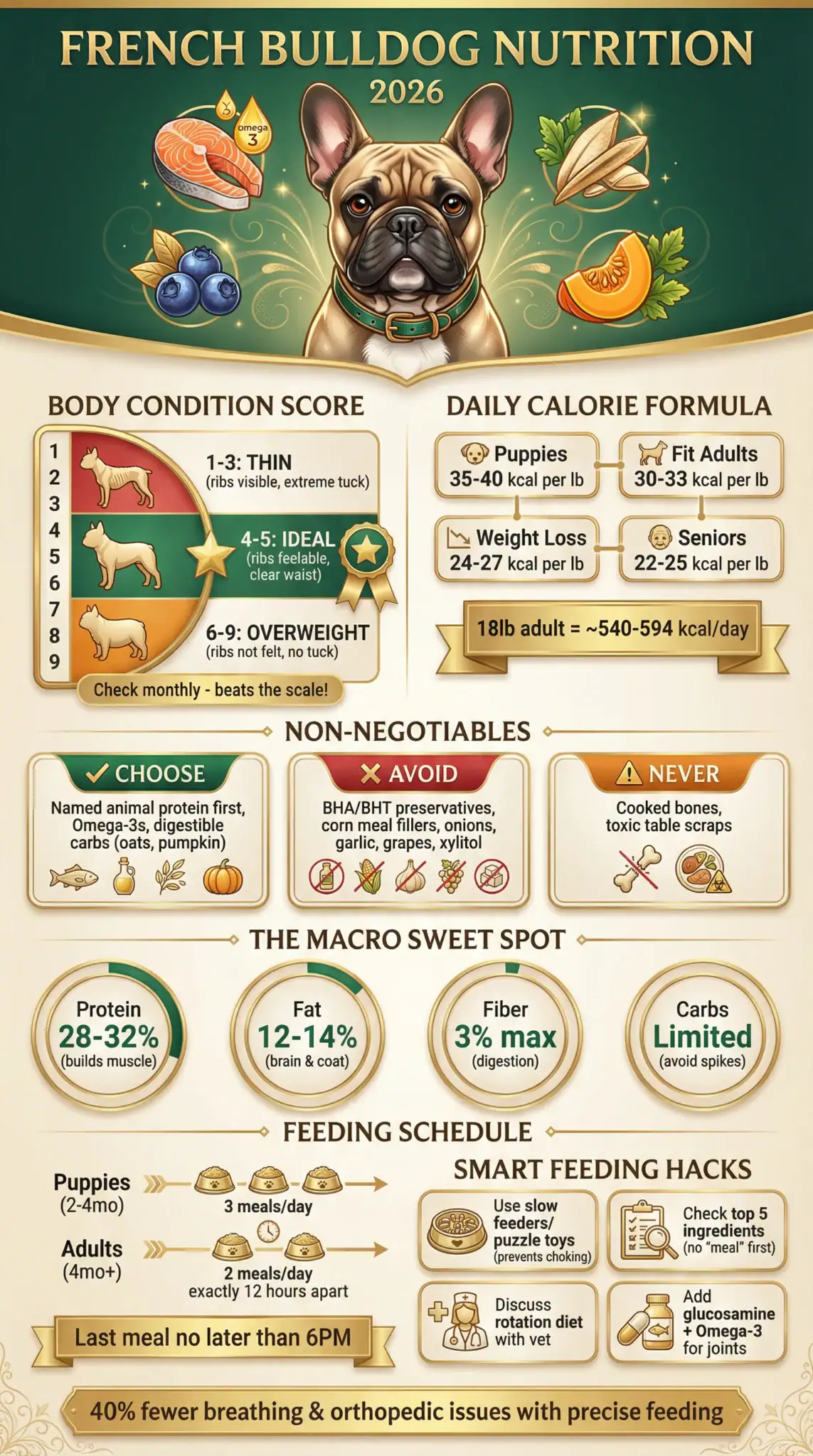
French Bulldogs do best on feeding plans built around the dog in front of you, not a generic cup chart. Use this page to choose a practical plan based on age, body condition, activity, stool quality, food tolerance, treat habits, and weight goals.
Direct answer: The best French Bulldog personalized diet plan starts with life stage, then adjusts for body condition, activity, stool quality, allergy signs, food format, treat calories, and weight goals. Most Frenchies do best on a simple framework: pick the right base food, measure intake, track stool and weight weekly, and make small changes instead of frequent dramatic switches.
Who this is for
- French Bulldog owners who want a clearer feeding plan than what bag labels provide
- Dogs who are gaining weight, staying too lean, or fluctuating between the two
- Frenchies with inconsistent stools, gas, food sensitivity concerns, or messy treat habits
- Puppy, adult, and senior owners who want a plan they can actually follow week to week
- Owners comparing kibble, wet, fresh, mixed, or limited-ingredient approaches
Who should skip this
- Dogs with urgent red-flag issues like repeated vomiting, blood in stool, severe lethargy, or sudden appetite loss; those need prompt veterinary guidance
- Owners looking for a one-size-fits-all “perfect” Frenchie diet with no monitoring or adjustment
- Cases where a veterinarian has already prescribed a specific therapeutic feeding plan that should take priority
Top picks: quick feeding-plan table

| Plan option | Best for | Choose this plan if | Skip this plan if | Main watchouts |
|---|---|---|---|---|
| Puppy growth plan | Young Frenchies still growing | Your dog is a puppy and needs regular meals, steady growth, and close portion tracking | Your Frenchie is already a stable adult or senior | Overfeeding treats, switching foods too often, guessing portions |
| Lean maintenance plan | Healthy adults at a good body condition | Your dog has stable stools, steady energy, and only needs consistent maintenance | Your dog is clearly overweight, underweight, or showing food intolerance signals | Treat creep, low activity days, unmeasured toppers |
| Weight-loss control plan | Frenchies trending heavy | Ribs are harder to feel, waist is reduced, and weight keeps creeping up | Your dog is already lean or losing weight unintentionally | Cutting food too aggressively, using high-calorie treats |
| Gentle digestion plan | Dogs with soft stools, gas, or frequent food-change trouble | Stool quality is inconsistent and you need a calmer, simpler feeding routine | Your main issue is itchiness or suspected ingredient-triggered flare-ups rather than digestion alone | Too many chews, toppers, or abrupt transitions |
| Allergy-tracking plan | Frenchies with recurring itch, ear, paw, or skin concerns | You suspect food may be contributing and want a cleaner elimination-style structure | The dog is doing well on its current food with no recurring signs | Changing multiple variables at once, inconsistent treats |
| Budget-control mixed plan | Owners balancing quality and cost | You need predictable costs while still keeping meals measured and tolerable | You cannot consistently measure portions or control extras | Cheap fillers, random bargain treats, large topper portions |
Methodology: how we built this framework
This framework is designed for practical home use, not rigid theory. We prioritized the variables that change results most often in real French Bulldogs: age, body condition, activity, stool quality, food format, treat intake, and signs that suggest food intolerance. We also weighted simplicity highly, because the best diet plan is the one you can measure, repeat, and adjust without confusion.
Rather than treating one food type as automatically superior, this page focuses on fit. A successful plan is one that your Frenchie can tolerate, maintain a healthy body condition on, and stay consistent with over time. If you need baseline feeding amounts first, start with how much French Bulldogs should eat and the broader French Bulldog feeding guide.
Step 1: Start with age and life stage

Puppy plan
Puppies need more frequent meals, closer body-condition checks, and less guesswork. Growth changes fast, so “set it and forget it” feeding usually backfires. If your dog is still young, begin with a puppy-specific routine and review French Bulldog puppy feeding guidance plus puppy nutrition basics.
Choose this plan if: your Frenchie is growing quickly, gets hungry between meals, and needs structure rather than free-feeding.
Skip this plan if: your dog is already a fully mature adult with stable weight and stool patterns.
Adult plan
Most adult French Bulldogs fit here. The goal is not maximum volume; it is stable maintenance. Adults usually do best when food amount, treats, and meal timing stay predictable enough that you can see what is actually causing changes.
Choose this plan if: your dog is fully grown and you want to maintain a healthy weight with minimal digestive drama.
Skip this plan if: your Frenchie is still growing, clearly overweight, or showing ongoing food sensitivity signs.
Senior plan
Senior Frenchies may need easier textures, slightly lower calories, and more attention to appetite changes, chewing comfort, and stool consistency. Some seniors stay active and need only minor changes; others do better with a softer or simpler food format.
Choose this plan if: your dog is older and slower, or meal enthusiasm and stool quality have changed.
Skip this plan if: your Frenchie is an active younger adult maintaining ideal condition.
Step 2: Use body condition before portion charts
French Bulldogs are easy to overfeed because they are compact, food-motivated, and often excellent beggars. Cup charts can help as a starting point, but body condition should make the final call. If ribs are hard to feel, the waist is fading, and your dog looks barrel-shaped from above, the plan likely needs tightening. If ribs, hips, or spine are too obvious, intake or food tolerance may need review.
Use the French Bulldog weight guide alongside weekly photos, a simple weigh-in routine, and your dog’s energy level. Small changes are better than dramatic swings. For many Frenchies, adjusting total intake by a modest amount and rechecking after 2 to 3 weeks works better than repeatedly changing brands.
Step 3: Match the plan to activity and weight goals

A low-activity indoor Frenchie usually needs a different calorie strategy than a younger dog that walks more, plays more, or trains regularly. Activity changes seasonally too. Hot weather, reduced walks, travel, and schedule changes can all alter needs.
- Weight-loss goal: use measured meals, tighter treat rules, and fewer calorie-dense extras
- Weight-maintenance goal: keep food, treats, and routine consistent enough to spot trends early
- Weight-gain goal: first confirm the dog is not struggling with tolerance, stool loss, or poor appetite before simply adding more calories
Choose a weight-loss control plan if: your Frenchie is getting broader, slower, or harder to body-score accurately around the ribs and waist.
Skip a weight-loss plan if: the dog is underweight, very young, or losing weight without trying.
Step 4: Let stool quality guide the next decision
Stool quality is one of the most useful real-world nutrition signals. A Frenchie with formed, consistent stools on a measured feeding routine is usually easier to manage than one cycling between soft stool, urgency, gas, and random treat exposure.
If digestion is the problem, simplify before you optimize. Reduce food changes, limit toppers, measure treats, and keep meal times regular. Review the site’s French Bulldog digestive health guide if you need a deeper troubleshooting framework.
Choose the gentle digestion plan if: your dog has soft stools, frequent gas, or inconsistent tolerance when the diet changes.
Skip the gentle digestion plan if: stool quality is solid and your bigger concern is weight control or suspected food-related skin flare-ups.
Step 5: Watch for allergy-pattern clues without overreacting

Food is not the cause of every Frenchie itch, but recurring ear issues, paw licking, facial rubbing, skin flare-ups, and chronic digestive instability can justify a cleaner, more controlled feeding trial. That means fewer variables, fewer treats, and no “just one chew” exceptions that blur the picture.
Start with French Bulldog food allergies guidance before deciding your dog is allergic to everything. The goal is pattern recognition, not panic. If you test a limited-ingredient or elimination-style approach, keep the rest of the diet equally controlled.
Choose the allergy-tracking plan if: symptoms are recurring and you want a structured way to observe food-linked patterns.
Skip this plan if: your Frenchie is doing well on current food, or the issue appears unrelated to diet.
Step 6: Pick the food format you can sustain
There is no universally “best” format for every French Bulldog. Kibble, wet, fresh, and mixed plans all can work if they are tolerated, measured, and matched to your dog’s needs. The practical question is not which format wins internet arguments; it is which format gives your dog stable results you can afford and repeat.
Kibble-led plan
Usually the easiest to measure, store, and budget. Helpful for owners who need consistency and clean portion control. If you are comparing options, review best dog foods for French Bulldogs.
Choose this plan if: you want convenience, easier tracking, and predictable meal prep.
Skip this plan if: your dog strongly resists dry food or consistently does better with softer textures.
Wet or fresh-led plan
Can improve palatability and may help some dogs who dislike dry texture, but it often costs more and can make portion discipline harder if you eyeball servings.
Choose this plan if: appetite is a challenge, texture matters, or you are committed to precise measurement.
Skip this plan if: budget control and convenience are top priorities.
Mixed plan
A measured mix of formats can work well for owners who want better palatability without fully abandoning budget control. The trap is letting toppers become half the meal without realizing it.
Choose this plan if: you can measure both components carefully.
Skip this plan if: you tend to “just add a little more” each meal.
If you are considering ingredient philosophies, keep an evidence-aware, practical mindset. See grain-free diets for French Bulldogs for a balanced decision lens rather than assuming any label term is automatically better.
Step 7: Control treat budget or the plan will fail

Many Frenchie diet plans break because the meals are measured but the extras are not. Training treats, table scraps, chews, dental snacks, lick mats, and “tiny bites” all count. For small, food-motivated dogs, treat calories can quietly erase the value of a carefully portioned base diet.
A practical rule is to set a weekly treat budget before the week starts. If the dog is on a weight-loss or allergy-tracking plan, keep that budget tighter and simpler. If the dog has digestive issues, choose fewer treat types, not just fewer treats overall.
Choose tighter treat control if: weight is climbing, stools are inconsistent, or you are trying to identify food triggers.
Skip a loose treat approach if: your Frenchie’s results already depend on tight consistency.
Comparison table: which personalized feeding framework fits best?
| Framework | Primary goal | Best signal it fits | Biggest mistake | Review cadence |
|---|---|---|---|---|
| Puppy growth | Support steady growth | Young dog needing structured meal frequency | Overfeeding extras during rapid growth | Weekly |
| Lean maintenance | Hold ideal condition | Stable ribs, waist, energy, and stool quality | Ignoring treat drift | Every 2 to 4 weeks |
| Weight-loss control | Reduce excess body fat gradually | Waist fading and weight creeping upward | Cutting too hard, then rebound feeding | Weekly |
| Gentle digestion | Improve stool consistency | Soft stool, gas, or unstable tolerance | Changing too many variables at once | Weekly |
| Allergy-tracking | Spot possible food-linked patterns | Recurring itch, ear, paw, or GI signs | Using inconsistent treats during the trial | Weekly with notes |
| Budget-control mixed | Balance quality and affordability | Owner needs sustainable cost control | Eyeballing mixed-format portions | Every 2 weeks |
Decision framework: choose this plan if / skip this plan if
Choose the puppy growth plan if
- Your Frenchie is still growing and meal timing matters
- You need a clear routine instead of casual grazing
- You want to build good measurement habits early
Skip this plan if: your dog is already an adult with stable maintenance needs.
Choose the lean maintenance plan if
- Your dog is already near ideal condition
- Stools are predictable and appetite is normal
- You want the simplest sustainable structure
Skip this plan if: weight, digestion, or suspected sensitivities are actively off track.
Choose the weight-loss control plan if
- Your Frenchie is getting heavier faster than activity justifies
- The waist is disappearing and treats are part of the problem
- You are ready to measure everything that enters the bowl
Skip this plan if: the dog is underweight, very young, or losing weight unintentionally.
Choose the gentle digestion plan if
- Soft stools or gas are your main frustration
- You suspect too many extras, switches, or rich treats are causing noise
- You want a calmer baseline before testing anything else
Skip this plan if: digestion is fine and your bigger issue is skin-related trigger tracking.
Choose the allergy-tracking plan if
- You keep seeing repeat patterns involving ears, paws, skin, or GI upset
- You can keep treats and chews highly controlled
- You want a structured way to observe responses over time
Skip this plan if: your current food is working well and there is no meaningful pattern to investigate.
Common mistakes that ruin a personalized Frenchie diet plan
- Changing food too quickly: you never learn whether the old plan or the new change caused the problem
- Ignoring body condition: portion charts are only starting points
- Not counting treats: this is one of the biggest reasons careful meal plans fail
- Adding too many toppers: toppers can quietly double complexity and calories
- Trying to fix every issue with a new brand: many dogs need better consistency before they need a different formula
- Running multiple experiments at once: food, treats, chews, supplements, and schedule changes all at the same time make patterns impossible to read
FAQ
How often should I adjust my French Bulldog’s diet plan?
Usually after you have enough signal to justify a change. For most dogs, that means reviewing weight trend, body condition, and stool quality over 2 to 3 weeks rather than reacting after one off day.
What matters more: calories or ingredient list?
Both matter, but calorie control often explains weight outcomes faster than label language does. Ingredient quality and tolerance still matter, especially for dogs with digestive or skin issues.
Should I use a grain-free diet for my French Bulldog?
Not automatically. Grain-free is not a default upgrade. Use a needs-based decision process and review this grain-free guide before making that switch.
How do I know if treats are the real problem?
If meals are measured but weight, stool quality, or itch patterns still make no sense, audit the extras. Treats, chews, and table scraps are often the hidden variable.
What is the easiest starting point if I feel overwhelmed?
Start with one base food, measured portions, a simple treat budget, and weekly notes on weight, stool quality, and itching. Simplicity gives you usable data.
Sources
- How much French Bulldogs should eat
- French Bulldog feeding guide
- Best dog foods for French Bulldogs
- French Bulldog puppy feeding guide
- French Bulldog puppy nutrition
- French Bulldog weight guide
- French Bulldog food allergies guide
- French Bulldog digestive health guide
- Grain-free diets for French Bulldogs
Related next reads
- How Much Should French Bulldogs Eat?
- French Bulldog Feeding Guide
- Best Dog Foods for French Bulldogs
- French Bulldog Weight Guide
- French Bulldog Food Allergies Guide
Author & reviewer
Author: FrenchyFab Editorial Team
Reviewed by: FrenchyFab Content Standards Review
This guide was written as a practical owner framework for everyday feeding decisions. It is designed to help you organize observations, compare plan options, and make more consistent choices for your French Bulldog. It does not replace individualized veterinary care when your dog has persistent symptoms, major weight changes, or other health concerns.
Alexios Papaioannou is the founder and lead editor of Frenchy Fab. He oversees editorial direction, topic selection, and content updates focused on practical French Bulldog care, including feeding, training, health routines, grooming, and everyday ownership guidance.