
French Bulldog essentials
Quick buyer checklist for safer Frenchie gear, food, cooling, and feeding support.
French Bulldogs need careful fit, airway-safe gear, heat precautions, and digestion-aware choices. Use these product searches as a starting point, then confirm sizing, ingredients, and vet guidance for your dog.
Disclosure: Some product links may be affiliate links. If you buy through them, we may earn a commission at no extra cost to you. For breathing problems, allergies, overheating, vomiting, or sudden appetite changes, ask your veterinarian first.
Quick Answer: For a French Bulldog that pulls, the best harness is breathable, fully adjustable around the chest and girth, has a front-clip attachment point for no-pull leverage, distributes pressure away from the throat, and is measured precisely to your dog’s body. A harness that fits well and a consistent no-pull training plan together solve pulling more effectively than either alone. This guide covers the exact features to look for, the best product types, a size chart for Frenchies, and a step-by-step no-pull training plan.
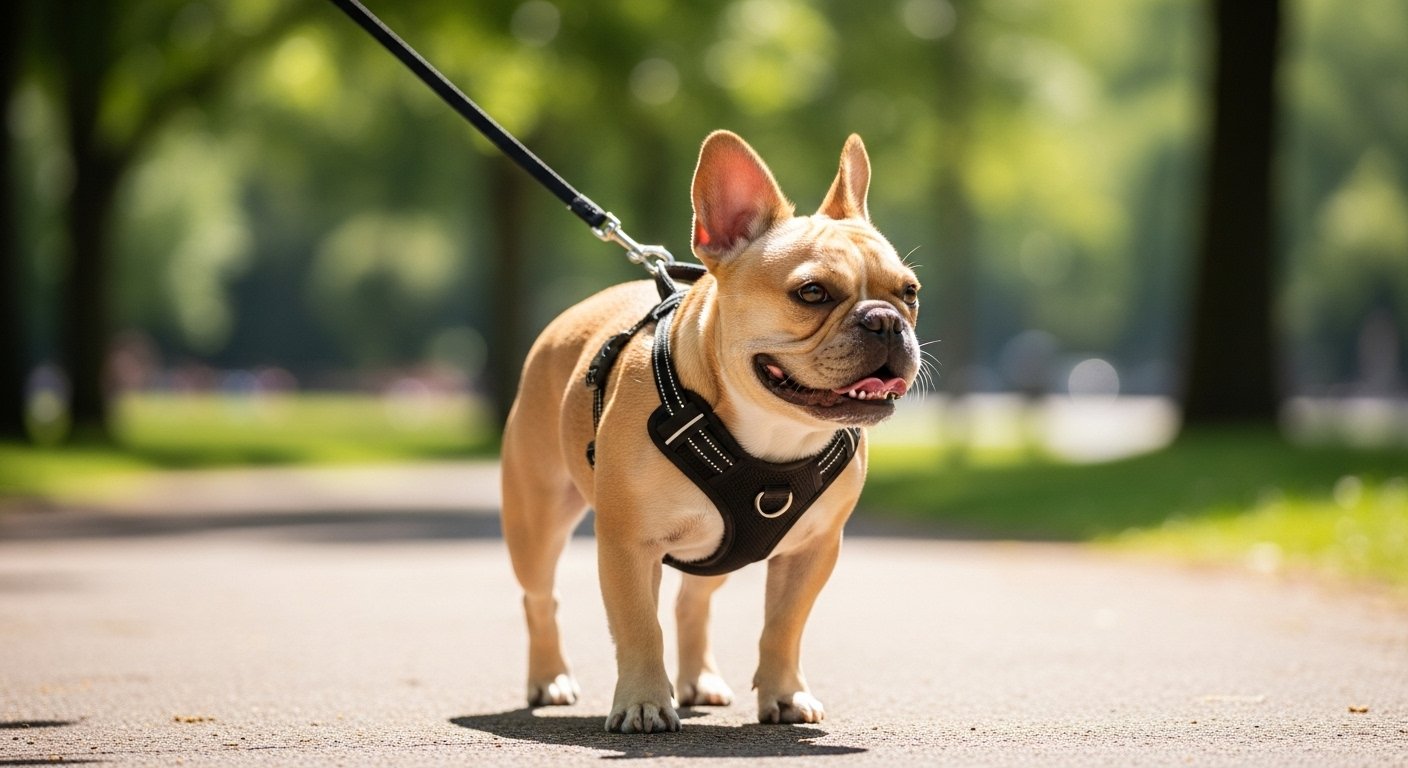
Why French Bulldogs Pull (And Why It Matters More for This Breed)
French Bulldogs pull for the same reasons most dogs do: excitement, environmental interest, insufficient leash training, or wanting to reach something ahead. But for Frenchies, pulling is more than a training inconvenience — it is a health risk. Their compromised airways mean that collar pressure can cause gasping, gagging, and dangerous oxygen deprivation during pulling episodes.
A front-clip no-pull harness addresses both problems simultaneously: it makes pulling less effective and prevents throat pressure. Combined with training, it is the most responsible tool for any Frenchie owner.
What to Look For in a No-Pull Harness for French Bulldogs
| Feature | Why It Matters for Frenchies | Priority |
|---|---|---|
| Front-clip attachment (chest ring) | Turns dog toward you when they pull; no-pull effect without pain | Essential |
| Back-clip option (dual-clip) | Useful once trained; can use for casual walks | Recommended |
| 2–4 point adjustment | Frenchies have unusual proportions; one-size does not fit | Essential |
| Breathable mesh panels | Frenchies overheat easily; solid neoprene traps heat | Essential |
| Padded chest strap | Prevents rubbing on sternum and front leg pits | Recommended |
| Quick-release buckles | Fast removal if Frenchie becomes distressed | Recommended |
| Traffic/emergency handle | Useful for managing in crowds or picking up a dog | Nice to have |
| Reflective stitching | Visibility in low light for short-nosed breeds | Nice to have |
French Bulldog No-Pull Harness Size Chart
Frenchies vary significantly in chest width for their weight. Always measure — do not guess by weight alone.
| Size | Chest Girth | Neck Circumference | Example Frenchie |
|---|---|---|---|
| XS | 38–43 cm / 15–17″ | 28–33 cm / 11–13″ | Puppies, petite adults under 8 kg |
| S | 43–50 cm / 17–20″ | 33–38 cm / 13–15″ | Average adult Frenchie, 8–11 kg |
| M | 50–58 cm / 20–23″ | 38–44 cm / 15–17″ | Larger Frenchies, 11–15 kg |
How to measure chest girth: Wrap a soft tape measure around the widest part of the chest, just behind the front legs. You should be able to fit one finger between the tape and the body. For neck circumference, measure around the base of the neck where a collar would sit.
The 2-Finger Fit Test: Always Check After Buying
After fitting the harness, perform the 2-finger test at every strap: you should be able to slide two fingers comfortably between the strap and your Frenchie’s body. If three fingers fit easily, the harness is too loose. If one finger barely fits, it is too tight.
- After walks: check for any redness, fur loss, or hair wear marks
- In warm weather: check more frequently — dogs can lose condition and gain weight seasonally
- After grooming: coat changes can affect fit
No-Pull Training Plan: Step by Step

The front-clip harness makes no-pull training easier by creating a natural turning moment when your Frenchie pulls. This redirects their attention toward you. Training is still required — the harness is a tool, not a substitute for teaching.
Week 1–2: Foundation (Indoors and Low Distraction)
- Put the harness on before every training session; use treats to create a positive association
- Practice walking inside your home or a quiet garden
- When your Frenchie’s leash goes slack, reward immediately with a treat and praise
- When they pull, stop walking immediately; wait for them to look at you or ease the leash
- Reward attention to you — eye contact while leashed earns a treat
- Keep sessions to 5–10 minutes; end on a success
Week 3–4: Adding Distraction
- Move practice to a quiet street or a low-traffic outdoor area
- Increase session length gradually (10–15 minutes)
- Reward loose-leash walking more frequently in harder environments
- Stop and redirect whenever attention wanders away from you
Week 5+: Real-World Generalization
- Practice in your normal walking areas
- Reward at random intervals (variable ratio) rather than every time — this makes the behavior more durable
- Be consistent: everyone in the household must use the same rules
- Do not allow pulling even once — dogs learn that pulling sometimes works
- Gradually reduce treat frequency while maintaining praise
What NOT to Use for French Bulldogs That Pull
| Tool | Why to Avoid It |
|---|---|
| Prong/choke collar | Severe throat and airway trauma risk for brachycephalic breeds; painful and counterproductive |
| Martingale collar | Designed for sighthounds; still applies dangerous throat pressure for flat-faced breeds |
| Retractable/long leash for training | Reinforces pulling; too much freedom to learn from leash feedback |
| Head halti/head collar (unfamiliar) | Can cause neck injury if dog lunges suddenly; Frenchies with BOAS may struggle with muzzle pressure |
Buyer Checklist Before You Purchase
- Have you measured chest girth, neck circumference, and back length?
- Does it have a front-clip attachment point?
- Is it adjustable at both the chest and girth straps?
- Is the material breathable — mesh or lightweight fabric?
- Is there padding at pressure points to prevent rubbing?
- Can you do the 2-finger fit test comfortably?
- Is there a quick-release buckle for fast removal?
- Does the brand offer a sizing guarantee or easy exchange?
- Can you return it if it does not fit your Frenchie?
Frequently Asked Questions
Vets consistently recommend harnesses for French Bulldogs because collar pressure worsens their airway condition. Look for a front-clip padded harness with full adjustability. Your vet can provide brand recommendations based on your individual dog’s measurements and any specific health concerns.
Foundation loose-leash skills typically take 2–4 weeks of consistent training. Real-world generalization in all environments can take 2–3 months. Results depend on how consistently the rules are applied by everyone in the household and how much practice the dog gets. The front-clip harness accelerates the process significantly.
For dogs that actively pull, a front-clip harness is more effective because it creates a turning moment that reduces pulling motivation. A dual-clip harness offers both options — front for training and correction, back for relaxed walks once the dog has learned not to pull. For most Frenchies that pull, a dual-clip model offers the most flexibility.
Many Frenchies resist harnesses initially. Use counter-conditioning: place the harness near their food bowl for several days, then let them approach it and offer treats. Progress to touching it against their body before attempting to buckle. Never force it on — this creates lasting fear. Most Frenchies accept a harness within 5–7 days of positive introduction.
Yes, but choose a model with easy on/off (step-in or velcro-close rather than over-the-head) to avoid discomfort. Ensure the harness does not put pressure on arthritic joints in the shoulders or spine. A padded chest plate distributes weight more evenly for older dogs. Consult your vet about arthritis management alongside harness use.
See also: French Bulldog Harness Guide: Fit and Safety · Heat Safety and Walking in Warm Weather · Training Essentials and Tools

Frenchy Fab editorial profile focused on practical French Bulldog owner guidance, safety-aware care routines, nutrition, puppy care, grooming, training, and transparent product-review methodology. Content is educational and does not replace veterinary diagnosis or treatment.