
Quick Answer: The best French Bulldog harness is breathable, fully adjustable around the chest and girth, has a front-clip attachment point for no-pull leverage, distributes pressure away from the throat, and fits precisely to your dog’s body measurements. A harness that fits well combined with consistent no-pull training solves pulling more effectively than either alone. Measure your Frenchie’s chest girth, back length, and neck circumference before buying.
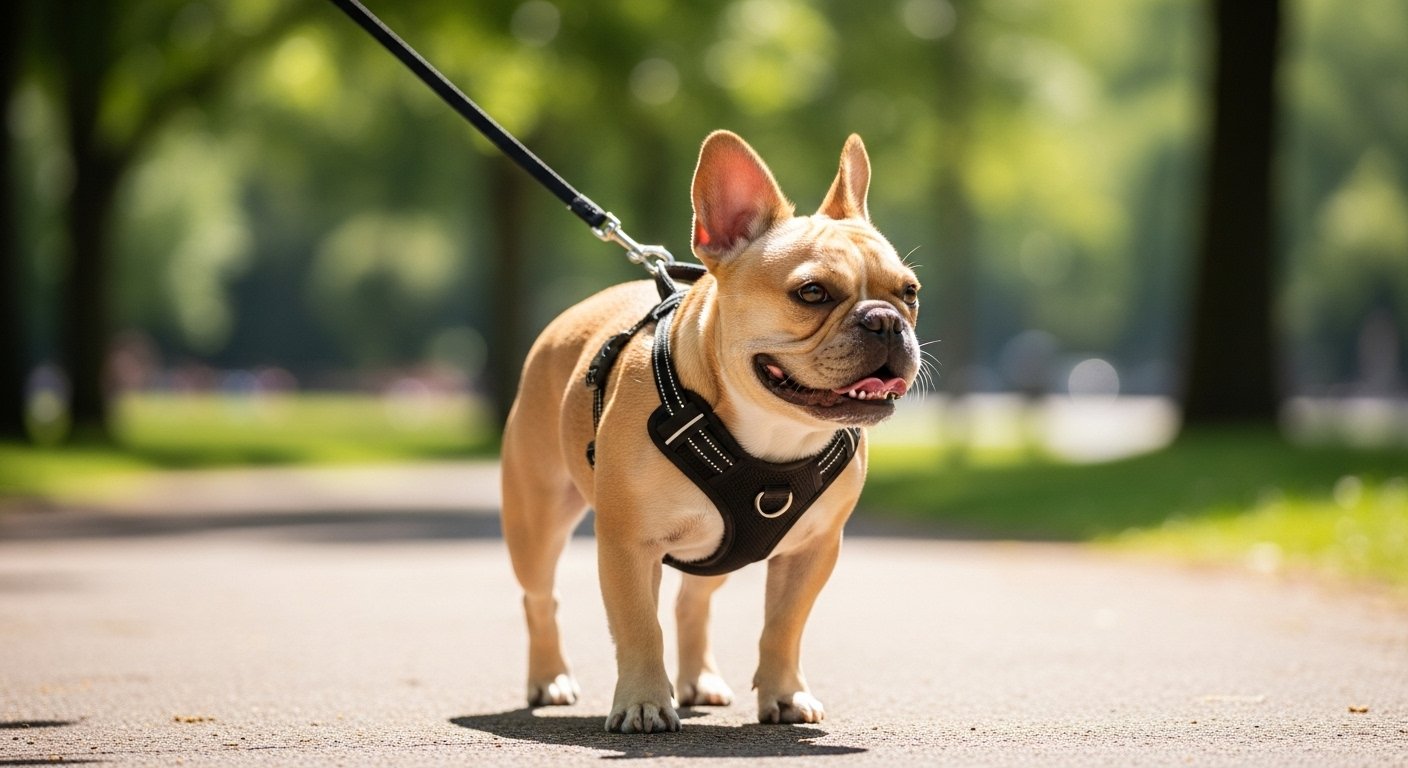
Why French Bulldogs Need a Harness (Not a Collar)
French Bulldogs are brachycephalic — they have flat faces and compromised airways. Any pressure on the throat from a collar worsens breathing difficulty, increases coughing and gagging, and can contribute to laryngeal collapse over time. A properly fitted harness moves all leash pressure to the chest and shoulders, bypassing the airway entirely.
Beyond airway safety, French Bulldogs’ compact body shape, wide chests, and short necks mean that standard dog harness sizing often does not fit them well. Getting the right fit — and the right type — makes a significant difference to daily comfort and safety.
Front-Clip vs. Back-Clip Harnesses: Which Is Better?
| Feature | Front-Clip Harness | Back-Clip Harness |
|---|---|---|
| Leash attachment | Ring on chest strap | Ring on back |
| No-pull effect | Yes — turning the dog when they pull | None — dog pulls forward |
| Best for | Pulling, reactivity, training | Casual walks, well-trained dogs |
| Airway pressure | None — chest-based | Minimal |
| Recommended for Frenchies | Yes — especially pullers | Only if already trained not to pull |
For French Bulldogs that pull, a front-clip harness is strongly recommended. It is the most effective non-aversive tool for reducing pulling without causing throat pressure or rewarding the pull with forward momentum.
French Bulldog Harness Size Chart
French Bulldogs typically fall into an unusual size range — wider in the chest than most small breeds, but shorter in length. Measure your Frenchie carefully before purchasing any harness.
| Size | Chest Girth (cm) | Neck Circumference (cm) | Recommended For |
|---|---|---|---|
| XS / 14″ | 38–43 cm | 28–32 cm | Small Frenchies, puppies under 6 months |
| S / 16″ | 43–50 cm | 32–38 cm | Average adult Frenchie (8–12 kg) |
| M / 18″ | 50–58 cm | 38–44 cm | Larger Frenchies (12–15 kg) |
How to measure: Wrap a soft tape measure around the widest part of the chest, just behind the front legs. Add 2–3 cm for comfort. For neck circumference, measure around the base of the neck where the collar would sit.
The 2-Finger Fit Test
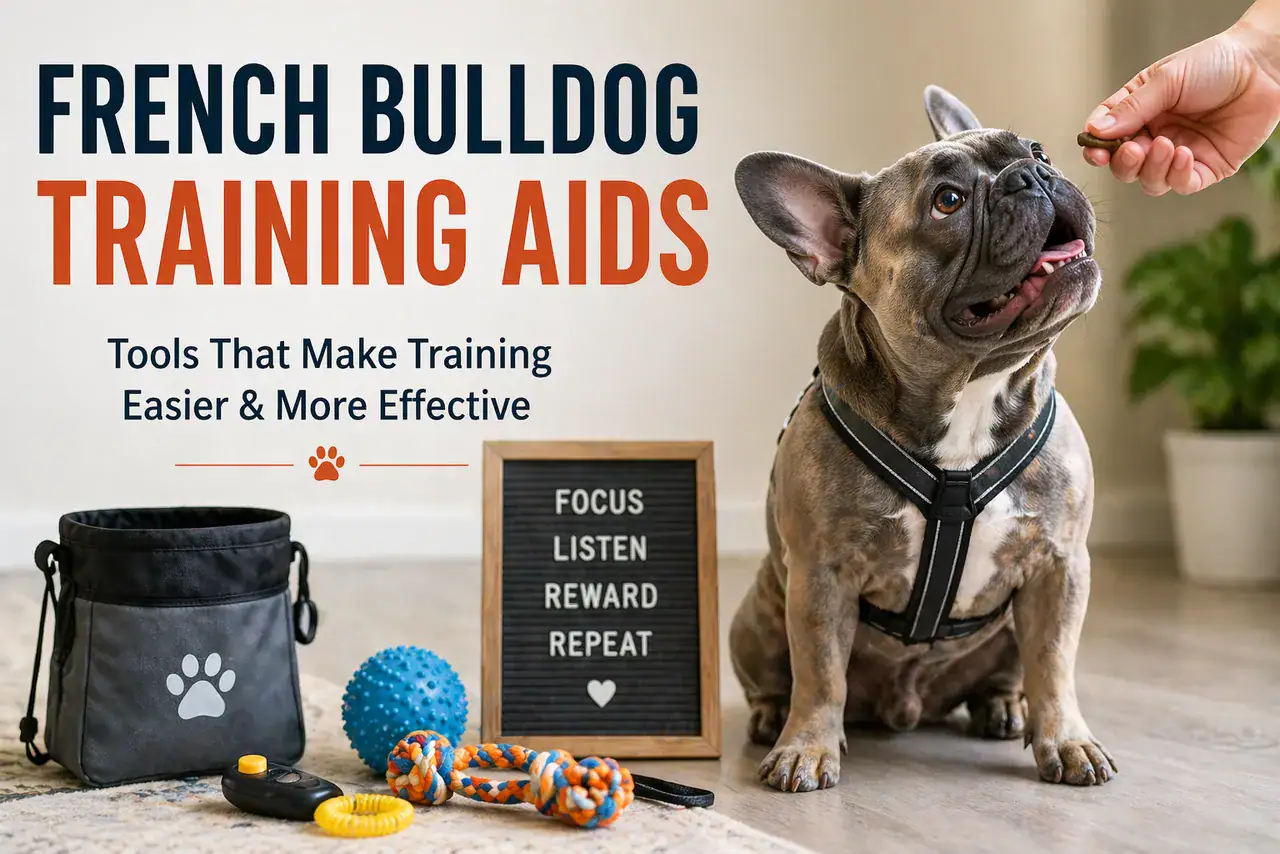
Once fitted, check the harness using the 2-finger test: you should be able to slide two fingers comfortably between any strap and your Frenchie’s body. If you can fit three fingers, it is too loose. If you can barely fit one, it is too tight.
- Chest strap: should sit well behind the front legs, not across the throat
- Girth strap: should be snug but not compress the ribs
- No-pinch points: check all adjustment points for exposed buckles that could pinch skin
- Range of motion: your Frenchie should be able to run, sit, and lie down comfortably
Heat and Airflow: A Critical Frenchie Consideration
French Bulldogs overheat quickly due to their compromised airways. A harness that covers a large portion of the chest or back can reduce heat dissipation. Look for:
- Mesh or breathable fabric panels rather than solid neoprene
- Minimal chest coverage — enough to distribute pressure but not trap heat
- Reflective strips for visibility without adding bulk
- Quick-release buckles for fast removal if your Frenchie becomes distressed
In warm weather, check harness fit more frequently — dogs can gain or lose condition seasonally, and a harness that fit perfectly in winter may be too tight by summer.
What to Avoid in a French Bulldog Harness
- Prong or choke chains: dangerous for brachycephalic breeds — severe throat and airway risk
- Martingale collars: designed for breeds with narrow heads; can still apply dangerous throat pressure for Frenchies
- Single-strap harnesses: do not distribute pressure evenly and can rotate
- Fixed-size harnesses: Frenchies’ unusual proportions mean custom adjustability is essential
- Harnesses that require stepping over the head: difficult with wide-chested breeds and arthritis-prone older Frenchies
No-Pull Training With a Front-Clip Harness
A front-clip harness makes no-pull training easier because it naturally turns your Frenchie toward you when they pull. The training principle is simple: reward the dog for walking in a loose leash position and change direction when they pull ahead.
- Start in a low-distraction environment (your home or quiet yard)
- Walk forward; when your Frenchie pulls, stop immediately
- Wait for the leash to go slack, then reward and continue
- Change direction when your dog pulls — this keeps their attention on you
- Keep sessions short (5–10 minutes) and end on a success
- Gradually increase distraction level as loose-leash walking improves
Buyer Checklist Before You Purchase
- Have you measured chest girth, neck circumference, and back length?
- Does the harness have both front and back clip options?
- Is it adjustable at both the chest and girth (not just one)?
- Is the fabric breathable — mesh panels or lightweight material?
- Are there padding points at pressure zones to prevent rubbing?
- Can you do the 2-finger fit test comfortably?
- Is there a quick-release buckle for emergencies?
- Has the harness been linked to brachycephalic or flat-faced dog comfort?
- Can you return it if it does not fit your Frenchie?
Frequently Asked Questions
For walks and daily activity, a harness is strongly preferred for French Bulldogs due to their airway vulnerabilities. A flat collar can be used briefly for ID tags if needed, but should not be the primary walking tool. Never leave a collar on an unsupervised dog — Frenchies can catch them on objects and injure themselves.
Most adult French Bulldogs need a size XS or S harness, depending on their chest girth. Measure around the widest part of the chest (just behind the front legs): 38–50 cm typically falls into XS–S. Larger Frenchies over 12 kg may need a size M. Always check the specific brand’s size chart rather than assuming.
A harness should be removed when your Frenchie is unsupervised, resting indoors, or in a crate. Extended wear can cause fur wear, skin irritation, or discomfort at pressure points. For daily walks, put the harness on before the walk and remove it afterward.
Introduce the harness gradually: place it near your Frenchie’s food bowl for a few days, then let them sniff it, then briefly hold it against their body without buckling. Reward with treats throughout. Do not force it on. Most Frenchies accept a harness within a week when introduced positively.
Front-clip no-pull harnesses work well for most French Bulldogs because the chest attachment point creates a turning moment when the dog pulls, redirecting their attention without causing pain or throat pressure. Consistency with training is key — the harness is a training aid, not a substitute for teaching loose-leash walking.
See also: Best Harness for French Bulldogs That Pull · Heat Safety and Walking Guide · Training Essentials

Frenchy Fab editorial profile focused on practical French Bulldog owner guidance, safety-aware care routines, nutrition, puppy care, grooming, training, and transparent product-review methodology. Content is educational and does not replace veterinary diagnosis or treatment.