
At a glance
When to call a vet
Avoid punishment, forced exercise, and training in heat or humidity. If breathing becomes noisy, labored, or your dog slows down sharply, stop and cool down.
What this guide helps you decide
- What matters first for a French Bulldog, not a generic dog.
- Which mistakes create health, training, or comfort problems.
- Where to go next in the Frenchy Fab care library.
Related Frenchy Fab guides
Quick Answer
French Bulldog Training Tips That Actually Work: use a baseline-first plan, make one change at a time, and review outcomes over 1–2 weeks before further adjustments.
Key Takeaways
- Prioritize consistency and measurable adjustments.
- Avoid abrupt changes that increase stress or digestive upset.
- Use veterinary guidance for persistent symptoms.
Use 3-5 second treats, one command at a time, and end every session on a win. Frenchies respond to food, play and praise—never yelling. Five-minute daily lessons beat marathon weekends.
French Bulldogs are food-motivated, people-oriented, and quick to learn when sessions stay short and fun. The tips below are the fundamentals that work for this breed’s build and temperament — no theory, just practical routines for real kitchens and busy sidewalks.
Key Takeaways
- Train before breakfast, use high-value treats, quit while you’re ahead.
- Pair every “sit,” “down,” “come” with an immediate marker word or click.
- Prevent jumping and biting by rewarding four paws on the floor.
- Keep lessons to 3-5 minutes; mental fatigue happens faster than physical.
- End each session with a cue like “all done” so your Frenchie knows the game is over.
Why French Bulldogs Aren’t Lazy—They’re Efficient
Frenchies are often called stubborn, but they are really strategic. Why sit when digging through the trash pays better? Change the pay-out structure and the behavior flips overnight. That’s the core of every tip below.
Tip 1: Start With the Big Three Commands

Focus on sit, down, come.
| Command | Purpose | First-Week Success Rate* |
|---|---|---|
| Sit | Default calm position | Fast — highly food-motivated breed |
| Down | Extended settle, vet visits | Reliable with daily reps |
| Come | Safety off-leash, door dashing | Solid, needs ongoing proofing |
*Success varies by dog and consistency of practice — these are common outcomes for reward-based training, not survey statistics.
Start with “sit” because it’s impossible for a Frenchie to jump and sit at the same time. Instant self-control. Need a step-by-step? Check basic commands for frenchies—it’s a quick place to start.
Watch: 60-Second Sit Demo
This clip shows how luring the nose up lets the rear drop into a sit. Notice the speed of the reward—before the butt lifts back up.
Tip 2: Use Food, Not Bribery
There’s a difference. Bribery waves cookie first; reward pays after the job. Keep treats in a pocket, mark the correct behavior with a cheerful “YES!”, then deliver the cookie within one second. Timing beats quantity—every time.
Tip 3: Schedule Micro-Sessions
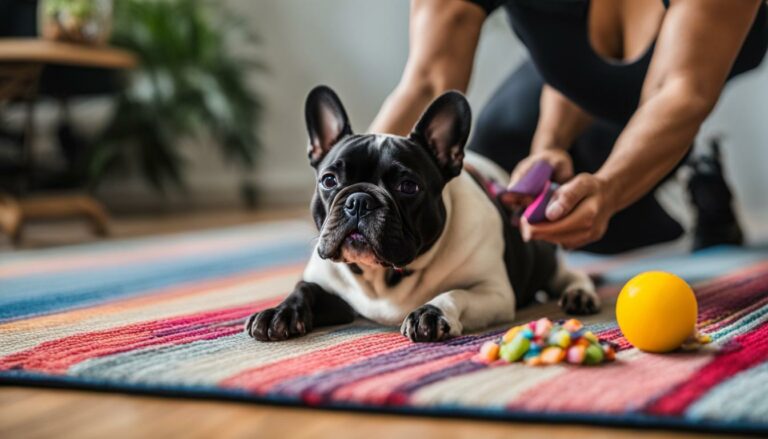
Frenchies fatigue fast. Short sessions work because they end before a Frenchie’s attention and breathing tire out — many trainers recommend keeping lessons to a few minutes and ending on a success
- Breakfast: practice “sit” while kibble aastes.
- Netflix ad break: three “down” reps.
- Pre-walk: door doesn’t open until butt hits floor.
Suddenly you’ve stacked 15 mini-lessons without carving out extra time. For more schedule hacks see french bulldog training at home.
Tip 4: Stop Jumping Before It Starts
Jumping is self-reinforcing; attention is the prize. Teach an incompatible behavior—four paws on floor—before guests arrive. Load a treat pouch, step on leash so the dog can stand/sit but can’t leave ground, then feed as visitors enter. Repeat ten times and jumping disappears.
If you’re past that point, don’t worry—there are more jump fixes in our stop french bulldog jumping guide.
Tip 5: Clicker = Clarity
Clickers slice through language noise. One click = one payoff—every single time. Many dogs pick up hand-targeting quickly with a clicker. Transition to a verbal marker once the lightbulb turns on.
New to clicker training? Read clicker training for french bulldogs for my three-day primer.
Puppy vs. Adult Approach
Puppies have tiny bladders and goldfish focus. Adults can work longer but carry baggage. Adjust expectations:
| Age | Session Length | Primary Reward | Key Focus |
|---|---|---|---|
| 8-12 weeks | 1-2 min | Kibble soaked in goat milk | Socialization & bite inhibition |
| 3-6 months | 3-4 min | Soft training treats | Name response, sit, recall |
| 6-18 months | 5-8 min | High-value freeze-dried meat | Leash manners, stay, leave-it |
| Adult rescue | 2-3 min, 2x/day | Whatever dog loves most | Trust, house training, basic cues |
“Adopted Frenchies often test you for three days, trust you in three weeks, and own your pillow in three months.” —Andre LeBlanc, LA-based certified trainer specializing in brachycephalics.
House Training Without Tears
My record: accident-free apartment in five days. The secret? Pre-emptive potty, not scolding puddles.
- Take puppy out every 60-90 min and immediately after sleeping, eating, or playing.
- Marker word “busy” as soon as pee starts—yes, mid-stream. Timing wires the association.
- Party = three tiny treats the second paws touch inside. Inside becomes the good place.
Full blueprint in house training french bulldog—it sets out the full routine.
Handling the Stubborn Reputation
Stubbornness is usually confusion, not defiance. Ask yourself:
- Have I practiced in three different rooms?
- Are treats worth working for?
- Am I repeating the cue louder (nagging)?
Lower distractions, raise pay, and the “stubborn” Frenchie transforms into a focused student. More mindset fixes at addressing french bulldog stubbornness.
Step-by-Step Puppy Training Day

Sometimes you need to see the flow. The next video follows a 16-week-old Frenchie through a real session: focus work, leash intro, and cooldown. Notice how the trainer ends with play—classical conditioning at its best.
Exercise: The Hidden Training Fuel
A mentally under-stimulated Frenchie invents hobbies like re-landscaping your slippers.
Need safe exercise ideas that respect flat-face anatomy? See french bulldog exercise needs and activities.
Useful Training Aids
- Treat pouch with clip—hands free, no fanny-pack dance.
- 6-ft lightweight leash—control without weight on the trachea.
- Clicker—box type; the button ones break in a week.
- Puzzle bowl—slows eating, doubles as brain game.
Full gear list, including my favorite allergy-friendly treats, is in french bulldog training aids.
Common Training Mistakes
- Using kibble the dog leaves in the bowl—low value equals low effort.
- Saying “sit, sit, SIT!”—one cue, one consequence.
- Allowing couch privileges Monday, banning Tuesday—consistency beats charisma.
Deep dive in french bulldog training mistakes.
When to Call a Pro
If your Frenchie growls over food, lunges at dogs, or panic-barks at noises, skip YouTube—book a certified trainer. Early intervention saves money and heartbreak. Search for IAABC or CCPDT credentials in your state.
And if anxiety is part of the puzzle, read french bulldog anxiety before your consult.
Keep It Fun: Games That Teach
Training doesn’t have to feel like homework. Try “find-it” in the hallway to reinforce scent work, “hide-and-seek” for recall, and “box bash” to shape rear-end awareness. Play keeps the tail wagging and the human smiling. Grab more boredom busters in training games and fun activities for french bulldogs.
Remember, your Frenchie wants to win; your job is to set up the game so victory is easy. Stack tiny wins, stay consistent, and you’ll have a polite shadow that pricks its ears the second you say “ready?”
Now load that pouch, set a timer for three minutes, and teach one perfect “sit.” Tomorrow you’ll add “down,” then “come.” Before the week is out you’ll wonder why you ever worried about stubbornness.
Frequently Asked Questions
- How long does it take to potty train a French Bulldog?
- With consistent outings every 60-90 min, most pups are reliable by 12-14 weeks.
- What treats work best for tough training days?
- Freeze-dried beef liver or turkey crumbles—tiny, smelly, swallow-fast.
- Can French Bulldogs do off-leash walks?
- Yes, but only after a bulletproof recall is proofed in fenced areas. Start with a 30-ft long line.
- Is crate training necessary?
- Not legally, but it speeds up housebreaking and prevents nighttime mischief. See our crate training guide for a gentle 7-day plan.
- My Frenchie barks at everything. Help?
- Pair the trigger with treats at sub-threshold distance, then gradually decrease space. Detailed protocol in french bulldog barking control.
Happy training!
Helpful References
Use these authoritative resources for deeper research and practical next steps.
Clear takeaway: French Bulldog training works best when it is short, calm, and consistent
Short answer: French Bulldogs usually respond better to brief, reward-based sessions than long drills. Focus on one behavior at a time, remove distractions, reward quickly, and keep the routine predictable so your dog understands what earns attention, food, play, or freedom.
How to use this guide
- Keep sessions short enough that your Frenchie still wants to participate.
- Prioritize recall, leash manners, crate comfort, and calm greetings before tricks.
- Adjust training around breathing, heat, age, and energy level.
Relevant next steps

Frenchy Fab editorial profile focused on practical French Bulldog owner guidance, safety-aware care routines, nutrition, puppy care, grooming, training, and transparent product-review methodology. Content is educational and does not replace veterinary diagnosis or treatment.