
Most adult French Bulldogs do best on 2 measured meals per day, usually totaling about 350 to 600 calories daily depending on age, ideal body weight, activity level, whether they are neutered, and the calorie density of their food. Puppies need more frequent meals and usually eat more per pound of body weight than adults. The fastest way to get feeding right is to start with your dog food label, compare it to your Frenchie’s body condition, and then adjust by 10% at a time instead of guessing.
If you want a full foundation first, see our complete French Bulldog feeding guide. If you are feeding a young dog, our French Bulldog puppy nutrition guide and French Bulldog puppy care article will help you set up the basics correctly.
French Bulldog feeding chart by age and life stage
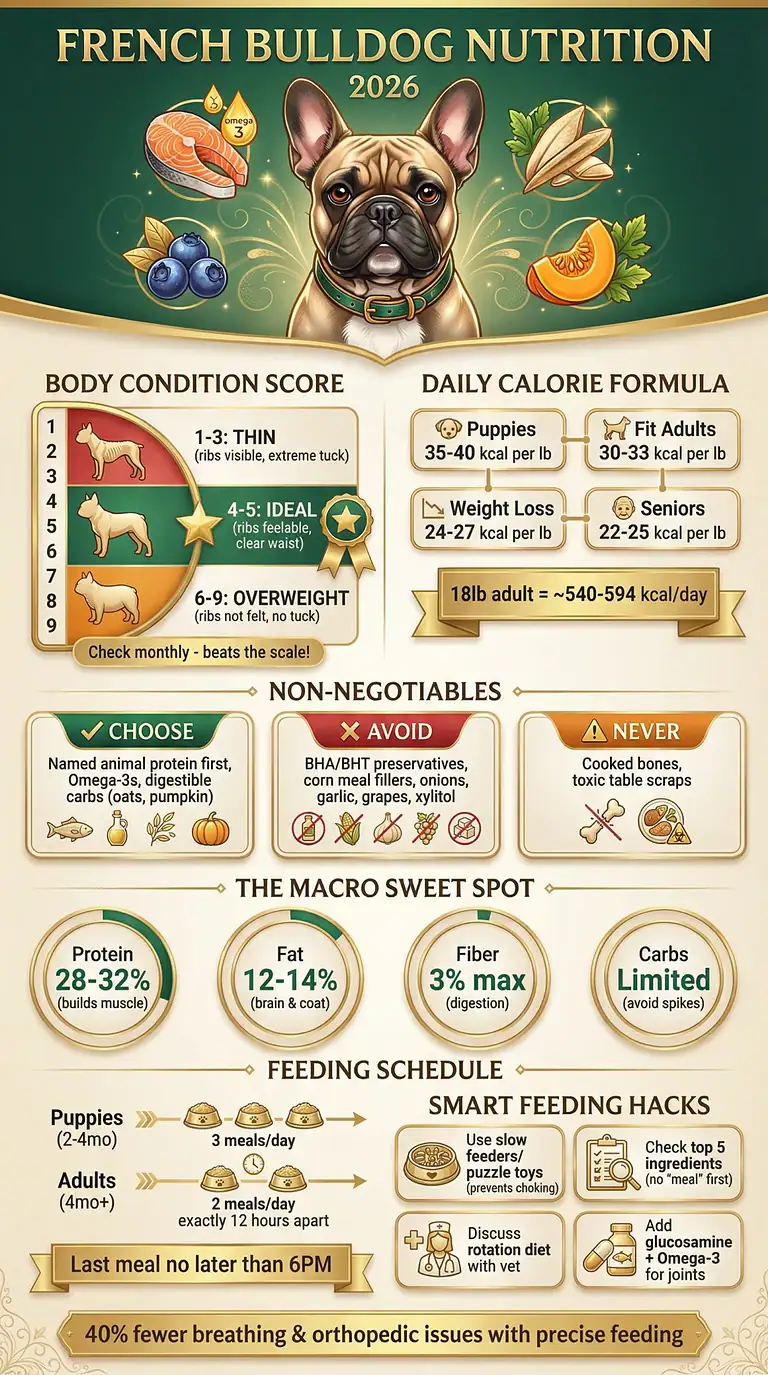
Use the chart below as a starting point, not a strict rule. These ranges assume a typical French Bulldog adult size of roughly 16 to 28 pounds and a food that provides about 350 to 420 calories per cup. Always check your food’s label because some formulas are much more calorie-dense than others.
| Life stage | Meals per day | Typical daily amount | Approx. calories per day |
|---|---|---|---|
| 8 to 12 weeks | 4 meals | 3/4 to 1 1/4 cups | 350 to 550 kcal |
| 3 to 6 months | 3 meals | 1 to 1 1/2 cups | 400 to 700 kcal |
| 6 to 12 months | 2 to 3 meals | 1 to 1 1/2 cups | 400 to 650 kcal |
| Adult (1 to 7 years) | 2 meals | 3/4 to 1 1/2 cups | 350 to 600 kcal |
| Senior (7+ years) | 2 meals | 1/2 to 1 1/4 cups | 300 to 500 kcal |
Important: Small, less active, or overweight Frenchies often need the low end of the range. Younger, intact, highly active, or underweight dogs may need more. For a deeper breakdown by age, see how often to feed your French Bulldog and our guide to adult French Bulldog feeding.
How to calculate how much your Frenchie should eat
The best feeding plan uses three inputs: your dog’s ideal weight, the calorie content of the food, and your dog’s body condition over the next 2 to 3 weeks.
- Check the food label for calories per cup, can, or tray.
- Start with the manufacturer’s range for your Frenchie’s ideal weight, not just their current weight.
- Split the total into meals based on age.
- Recheck body condition weekly and adjust up or down by about 10% if needed.
As a rough rule, many adult French Bulldogs maintain well at around 25 to 30 calories per pound of ideal body weight per day, but that varies a lot by metabolism and activity. That is why measured feeding and body condition matter more than any single formula.
How often should French Bulldogs eat?
Meal frequency matters because French Bulldogs are prone to overeating, begging, and digestive upset if portions are inconsistent.
- 8 to 12 weeks: 4 small meals
- 3 to 6 months: 3 meals
- 6 to 12 months: 2 to 3 meals
- Adults: 2 meals
- Seniors: usually 2 meals, sometimes smaller portions if digestion is sensitive
If you need a full schedule, read our French Bulldog meal frequency guide. Consistent meal timing also makes it easier to spot appetite changes early.
What nutrients matter most in a French Bulldog diet?
French Bulldogs do best on a complete and balanced diet formulated for their life stage. Focus on these basics:
- Protein: Supports muscle maintenance and growth. Quality animal protein is usually the easiest starting point.
- Fat: Provides energy and helps with skin and coat health, but too much can push calories up fast.
- Digestible carbohydrates and fiber: Can help stool quality and satiety.
- Omega-3 fatty acids: Useful for skin support in some dogs.
- Balanced calcium and phosphorus: Especially important during puppy growth.
- Water: Often overlooked, but essential for digestion, temperature regulation, and overall health.
If you are comparing foods, our roundup of the best dog foods for French Bulldogs can help you narrow down options without relying on marketing claims alone.
How to tell if you are feeding too much or too little
The scale matters, but body condition score matters more. A healthy Frenchie should generally have a visible waist from above and a slight abdominal tuck from the side. You should be able to feel the ribs under a light fat covering, not dig for them and not see them sharply sticking out.
Signs your French Bulldog may be eating too much:
- Weight gain over a few weeks
- No visible waist
- You cannot easily feel the ribs
- Reduced stamina or more strain with exercise
Signs your French Bulldog may be eating too little:
- Unplanned weight loss
- Pronounced ribs, spine, or hip bones
- Persistent hunger despite regular meals
- Low energy or poor muscle condition
If you are unsure what healthy looks like, use our French Bulldog weight guide as a checkpoint.
Treats, table scraps, and foods to avoid
Treats should stay at 10% or less of daily calories. It is very easy to overfeed a Frenchie with extras, especially if multiple family members give snacks throughout the day.
Choose lower-calorie rewards when possible. Our list of healthy treats for French Bulldogs is a good place to start. Just as important, know which foods are unsafe. Review what French Bulldogs should not eat before sharing any human food.
Food allergies, sensitive stomachs, and ingredient changes

Some French Bulldogs are prone to itchy skin, recurrent ear issues, gas, loose stool, or chronic digestive sensitivity. Those problems are not always caused by food, but diet can be one possible factor. If you suspect a food issue, avoid random ingredient switching and speak with your veterinarian about a structured plan.
For background reading, see our French Bulldog food allergies guide. When you do change foods, transition gradually over 7 to 10 days unless your vet advises otherwise.
Hydration and feeding habits that help Frenchies
French Bulldogs should always have access to fresh water. Good hydration supports digestion and helps dogs eating dry food maintain normal intake. Watch for sudden increases or decreases in drinking, especially if appetite also changes.
Practical feeding habits that help:
- Measure every meal with a scoop or kitchen scale
- Feed on a consistent schedule
- Track treats as part of total calories
- Reweigh your dog regularly
- Adjust portions slowly, not dramatically
Red flags: when to call your vet

Call your veterinarian if your French Bulldog has any of the following:
- Sudden refusal to eat or a major drop in appetite
- Repeated vomiting or diarrhea
- Rapid weight loss or gain
- Bloated abdomen, pain, or repeated retching
- Excessive thirst, lethargy, or weakness
- Choking, gagging, or trouble swallowing
- Persistent itching, ear infections, or skin flare-ups after meals
Frenchies can hide discomfort until a problem is more advanced, so a feeding change that looks minor on day one can matter if it lasts.
Bottom line
For most French Bulldogs, the right amount of food is not one fixed number. It is a measured daily calorie intake matched to age, ideal weight, activity, and body condition. Start with the feeding chart above, feed puppies more often than adults, monitor weight and waistline weekly, and adjust in small steps. If your dog’s appetite, stool, skin, or weight changes suddenly, involve your vet rather than guessing.

Frenchy Fab editorial profile focused on practical French Bulldog owner guidance, safety-aware care routines, nutrition, puppy care, grooming, training, and transparent product-review methodology. Content is educational and does not replace veterinary diagnosis or treatment.